Wicks & Fragrance
Flashpoint and IFRA Limits: Fragrance Safety for Candles
Learn what flashpoint and IFRA limits mean for candle making, how to add fragrance safely, and how to stay within safe usage rates.
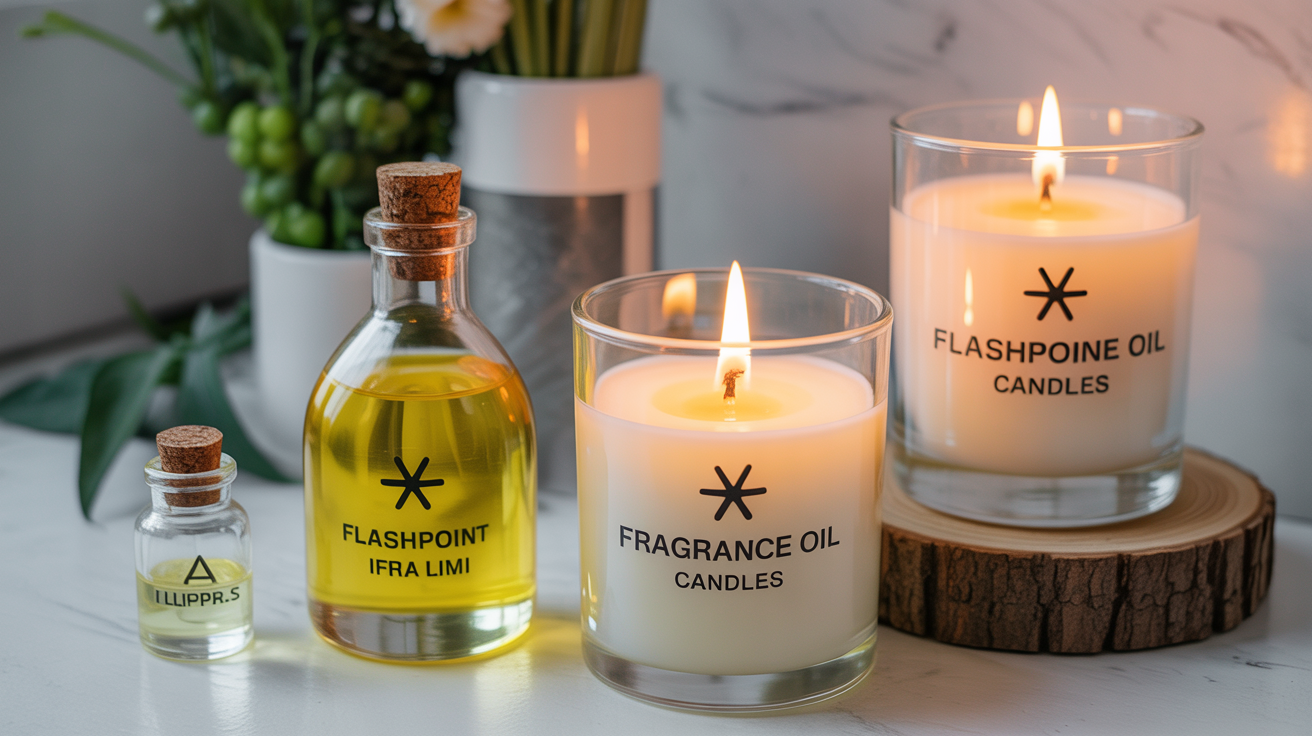
Fragrance oil is what turns a plain wax block into something people actually want to burn. But two terms show up on nearly every supplier's product page, and beginners often gloss over them: flashpoint and IFRA limits. Skipping past those numbers can lead to fragrance that burns off too fast, a candle that smokes, or a scent load that causes skin irritation if the wax ever contacts hands. Neither concept is complicated once you see what each one is actually measuring.
This guide breaks both down in plain terms, explains how to apply them when you're pouring, and walks through how they interact with fragrance load, so your finished candles smell great and behave safely.
At a Glance
- Flashpoint is a shipping and storage classification, not a "danger line" for adding fragrance. It's the lowest temperature at which a liquid's vapor can briefly ignite near an open flame.
- Add fragrance at or a few degrees below the flashpoint when your wax temperature allows it, and never so hot the oil smokes.
- IFRA (International Fragrance Association) sets usage caps by product category. Candles fall under Category 12, covering products that release fragrance by burning rather than skin contact.
- Most candle fragrance oils are formulated to be IFRA compliant up to 10-12% of total wax weight; a reputable supplier provides an IFRA conformity statement for each oil.
- Fragrance load and flashpoint are separate safety questions: one caps how much you use, the other caps how hot you add it. Both matter, and neither substitutes for the other.
- Essential oils don't automatically follow the same rules as fragrance oils; research each one, since flashpoints and IFRA data vary widely between them.
What Flashpoint Actually Means (and What It Doesn't)
Flashpoint is the lowest temperature at which a liquid can produce enough vapor to briefly ignite if an open flame passes over it. That's also the standard definition used across the chemical safety world: Wikipedia's entry on flash point describes it the same way, and distinguishes it from the related but higher "fire point," the temperature at which vapor keeps burning even after the ignition source is removed. Flashpoint testing is typically done with an open-cup or closed-cup apparatus, and closed-cup results usually run 5-10°C lower than open-cup results for the same liquid, since a sealed cup traps vapor more efficiently. For fragrance oils used in candles, you'll typically see flashpoints listed somewhere between 140°F and 200°F (60°C and 93°C), though some fall outside that range.
Here's the part that trips up a lot of new makers: a fragrance oil's flashpoint is not the temperature at which you have to add it to wax. It is not a "danger zone" number you must stay well below. It's simply a fire-classification figure that tells shippers and retailers how to store and transport the product. As a point of comparison, gasoline has a flashpoint of about -43°C (-45°F), which is why it's classified and shipped as a flammable liquid; a candle fragrance oil sitting at 150°F to 200°F flashpoint is a far less volatile substance by that same scale, even though it still deserves respect around open flame.
What the flashpoint does tell you is this: if you add fragrance at a temperature higher than its flashpoint, the volatile top notes can flash off before they're trapped in the wax, leaving you with a weaker cold throw and possibly a thinner scent profile once the candle cures. That's a quality issue, not necessarily a safety issue, as long as you're working carefully.
The practical rule most candle makers follow: add fragrance at or a few degrees below the flashpoint when possible, but never so hot that the oil smokes or ignites on contact. For most soy and paraffin blends, that means adding fragrance somewhere between 160°F and 185°F (71°C and 85°C). Always check your wax supplier's recommended pour temperature alongside the fragrance's flashpoint and use the lower of the two as your ceiling.
Work with a dedicated candy or candle thermometer. Guessing temperature by eye is how you get scorched fragrance, or worse, wax that's too cool to bind the oil properly and ends up separating.
How to Add Fragrance Safely to Hot Wax
Hot wax can cause serious burns at any stage of the process. Keep a lid nearby that fits over your pouring vessel, and never leave melting wax unattended. Having a fire blanket within reach is a sensible precaution, not overkill.
When you're ready to add fragrance:
- Pull your wax off the heat source once it reaches your target temperature.
- Let the temperature drop 5 to 10 degrees before adding the fragrance, especially if the oil has a flashpoint on the lower end.
- Add the fragrance oil slowly and stir steadily for about two minutes so it binds evenly through the wax.
- Check the temperature again before pouring. Fragrance added to wax that's too hot can separate and pool at the bottom of the container as the candle cools.
If you see the oil sitting on top after the candle sets, the wax was likely too cool or the fragrance wasn't stirred in long enough. If the scent fades quickly when you burn the candle, the wax was probably too hot when the oil went in.
For more on how wick choice affects scent throw and burn quality, how to choose the right candle wick covers the relationship between wick size and fragrance performance in detail.
What IFRA Limits Are and Why They Matter
IFRA stands for the International Fragrance Association. It's an industry body that sets usage guidelines for fragrance ingredients based on safety research, particularly around skin sensitization and allergen exposure. Those guidelines live in the IFRA Standards Library, a searchable, publicly browsable database of restriction, specification, and prohibition standards for individual fragrance ingredients, each tied to a specific chemical (identified by CAS number) and a publication or amendment date.
IFRA publishes standards that cap how much of a given fragrance compound can be present in a finished product, broken down by product category. Candles fall into IFRA Category 12, which covers products that are burned and release fragrance through combustion rather than skin contact.
Category 12 limits are generally higher than limits for rinse-off or leave-on products because candles aren't worn on skin. But the limits still exist, and reputable fragrance suppliers provide an IFRA compliance certificate (sometimes called an IFRA statement or IFRA conformity) with each fragrance oil. That document specifies the maximum percentage of that particular oil you can use in a Category 12 product.
In practice, most candle fragrance oils are formulated to be IFRA compliant at usage rates up to 10% or 12% of the total wax weight. If you're staying within those rates and your supplier provides a compliance certificate, you're working safely. Where makers get into trouble is using fragrance oils not designed for candles, like diffuser oils or perfume concentrates, which may not have Category 12 IFRA data at all.
If you ever resell or gift candles, having an IFRA certificate on file for each fragrance you use is standard practice and, in many markets, expected if a customer ever questions your ingredients.
Fragrance Load: Staying Within the Safe Range
Fragrance load is the percentage of fragrance oil by weight relative to the wax. A 6% load means 0.6 oz of fragrance per 10 oz of wax. The right load depends on the wax type, the jar size, and the specific fragrance.
Going too high doesn't just waste fragrance oil. It can cause:
- Fragrance pooling at the bottom of the jar
- Seeping or "sweating" on the surface
- A wick that can't push enough heat through the excess oil, leading to poor scent throw
- In worst cases, a fragrance fire if the pooled oil near the wick ignites
Most container waxes can handle between 6% and 10% fragrance load. Some high-fragrance soy blends are rated to 12%. Paraffin varies by grade. Check your wax supplier's recommended maximum, and treat that number as the ceiling, not the target.
For a full breakdown of how to calculate fragrance amounts by weight, how much fragrance oil to add to candles walks through the math with examples for different jar sizes.
Your wick choice also affects how a heavier fragrance load performs at the burn stage. A wick that runs too cool leaves fragrance unburned in the melt pool; one that runs too hot can cause the pool to deepen faster than the fragrance can disperse evenly. Candle wick types explained: cotton, wood and more covers how different wick materials handle heat and interact with fragrance-heavy wax.
Flashpoint vs. Fragrance Load: What Each Number Actually Controls
These two safety numbers get confused constantly, even though they answer different questions. This table lays out the distinction plainly.
| Flashpoint | Fragrance Load / IFRA Limit | |
|---|---|---|
| What it measures | Lowest temp at which vapor can briefly ignite near a flame | Maximum safe concentration of fragrance in wax by weight |
| Where you find it | Fragrance oil's technical/safety data sheet | Wax supplier's data sheet and the oil's IFRA certificate |
| Typical candle range | 140-200°F (60-93°C) | 6-10%, up to 12% for some soy blends |
| What happens if ignored | Scent volatilizes before setting; rare vapor-ignition risk near open flame | Sweating, pooling, weak burn, or, at extremes, sensitization risk |
| Who sets the standard | Individual manufacturer testing (open-cup or closed-cup method) | IFRA, via Category 12 usage standards |
Putting It Together: A Simple Pre-Pour Checklist
Before you add fragrance to any batch, run through these four checks:
- Wax temperature: Is it at or just below the fragrance's flashpoint? Have you pulled the pot off direct heat?
- IFRA compliance: Does your supplier provide a Category 12 IFRA statement for this fragrance?
- Fragrance load: Are you within the wax manufacturer's recommended maximum percentage?
- Stir time: Are you planning to stir for a full two minutes to make sure the oil binds?
Getting these right consistently is what separates candles that smell great through the full burn from ones that start strong and fade fast. It's worth building this checklist into a physical batch log, even a simple notebook page per pour, since the same fragrance oil at the same load can behave differently in a new wax blend or a different jar diameter. General fire and workspace precautions still apply on top of all this; the National Candle Association's candle safety guidance recommends working on a stable, heat-resistant surface away from anything flammable, which is just as relevant while you're mid-pour with an open pot of hot, fragranced wax as it is once the finished candle is burning.
Frequently Asked Questions
Does a higher flashpoint mean a fragrance is safer?
Not exactly. Flashpoint is primarily a shipping and storage classification. A fragrance with a high flashpoint isn't inherently safer to use than one with a lower flashpoint. What matters for safe use is following your wax's temperature guidelines, staying within the IFRA limits, and not exceeding your wax's maximum fragrance load.
What happens if I add fragrance above its flashpoint?
The main risk is that volatile aroma compounds burn off before they're fixed in the wax, weakening the final scent. There's also a small risk of the vapor igniting briefly if an open flame is nearby. This is why you should pull wax off the heat source before adding fragrance and avoid pouring over a gas flame.
How do I find the IFRA limit for a specific fragrance?
Ask your supplier for the IFRA conformity statement for that fragrance oil. Reputable candle fragrance suppliers include this with every product page or can provide it on request. The document lists the maximum usage percentage by IFRA category. For candles, look at Category 12. You can also browse restriction, specification, and prohibition standards directly by ingredient in the IFRA Standards Library if you want to check a specific chemical yourself.
Can I use essential oils instead of fragrance oils in candles?
Yes, but essential oils often have lower flashpoints than candle fragrance oils, and IFRA Category 12 data varies widely. Some essential oils also have maximum usage rates far below what most fragrance oils allow. If you're using essential oils, research each one individually rather than applying fragrance oil guidelines.
Why does my candle lose its scent after a few burns even though I used the recommended load?
Scent fading over multiple burns usually points to a wick that's slightly too large, which burns the fragrance off faster than the candle can refresh from the sides and bottom of the jar. It can also happen if the wax was too hot when the fragrance was added, causing some scent compounds to volatilize before the candle set. Test a slightly smaller wick size and double-check your pour temperature.
Is it ever legal to exceed the IFRA usage limit if I just use a smaller amount overall?
IFRA limits are expressed as a maximum percentage of the fragrance oil itself, not the fragrance compound in isolation, so a smaller overall fragrance load does keep you under the cap if the base fragrance oil is compliant. But this only holds if you're staying at or below the percentage on the IFRA certificate. There's no safe workaround for using a fragrance oil above its stated limit; the fix is always to reduce the load, not to reason around the number.
Do natural or "clean" fragrance oils skip the flashpoint and IFRA rules?
No. Any liquid, natural or synthetic, has a flashpoint, and IFRA standards apply based on the chemical composition of what's in the oil, not on marketing language. A fragrance oil labeled "natural" or "clean" still needs its own flashpoint data and IFRA Category 12 statement, and skipping that check because of the label is a common mistake among newer sellers.