Getting Started
How Long Does It Take to Make a Candle?
Find out how long candle making actually takes, from melting wax to cure time, so you can plan your first batch without any surprises.
If you are planning your first pour, one of the most practical questions you can ask is: how long does this actually take? The short answer is that active hands-on time is surprisingly short, usually under an hour, but the waiting that follows is where new makers get tripped up. Understanding the full timeline before you start means you will not burn your hand touching a jar that has not fully set, and you will not gift a candle that smells faint because it skipped the cure.
This guide breaks the process into each stage so you can plan a realistic schedule. Whether you want to pour on a weeknight or knock out a small batch for gifts over the weekend, knowing what comes when will save you a lot of frustration.
At a Glance
- Active hands-on work for a small batch (2-4 jars) runs about 45-60 minutes: setup, melting, adding fragrance, and pouring.
- Small jars firm up in 2-4 hours; larger vessels take 4-8 hours; pillars can take up to 24 hours to solidify fully.
- Soy candles need 1-2 weeks of cure time for full scent throw; paraffin needs only 48-72 hours; beeswax needs as little as 24-48 hours.
- Total time from pour to a candle at its best is realistically 1-2 weeks, almost all of it unattended waiting.
- Never move a candle while wax remains liquid in the center. Jostling before it firms up causes sinkholes and uneven tops.
- Batch size changes hands-on time roughly in proportion, but cooling and cure time stay about the same regardless of how many jars you pour.
The Hands-On Stage: Melting, Fragrance, and Pouring
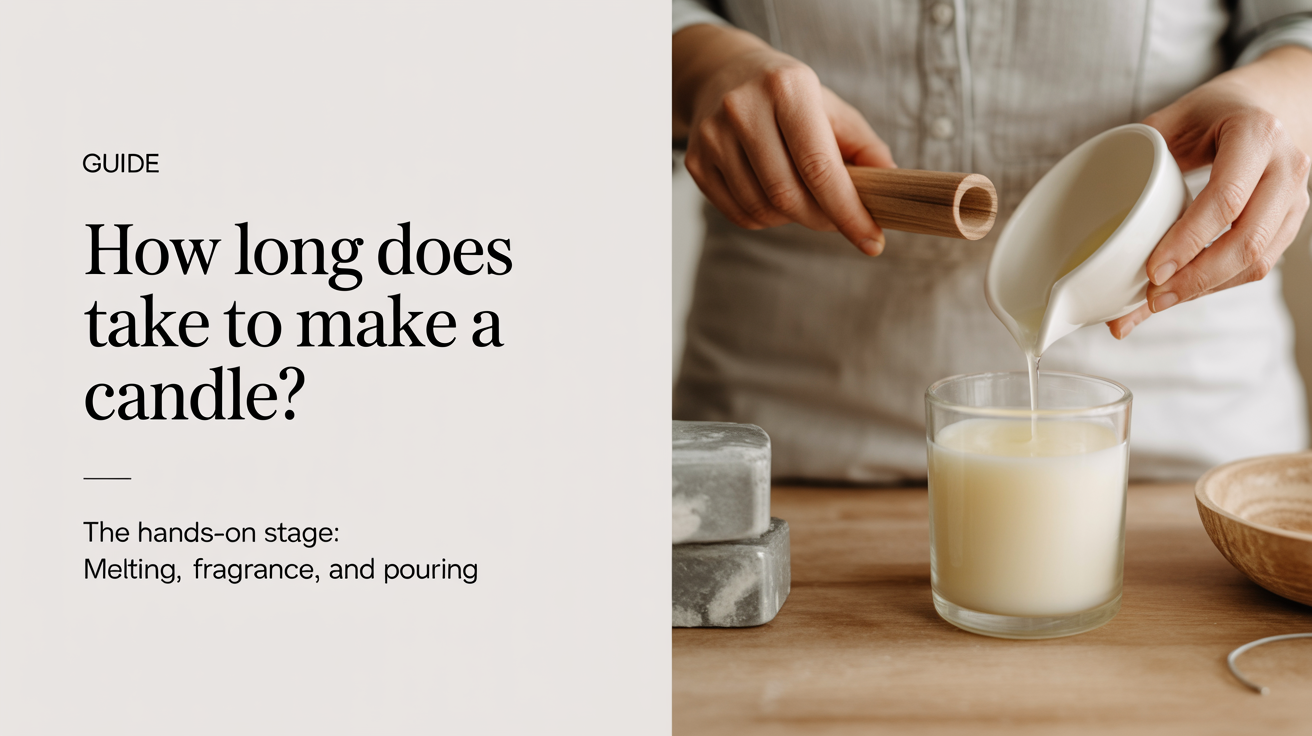
The part of candle making that requires your actual attention runs from setup through the pour. For a small batch of two to four container candles, budget about 45 minutes to an hour for this stage.
Here is what fills that time:
Setup (5 to 10 minutes). You need to center and anchor your wicks, measure out wax, and get your double boiler going. If you are new to the supplies and tools involved, spending a few extra minutes organizing before you melt anything will make the session run much more smoothly.
Melting (20 to 30 minutes). Wax melts slowly in a double boiler, and that is by design. Direct heat is a burn risk and can scorch your wax. Most soy waxes are fully melted by around 170 to 180°F (77 to 82°C), while paraffin often needs 180 to 200°F (82 to 93°C) depending on the grade. Keep your thermometer in the pot and stay nearby. Do not crank the heat trying to speed this up. Overheated wax can discolor, and wax near an open flame is a fire hazard. All candle waxes are hydrocarbons at heart, chains of carbon and hydrogen atoms, and the National Candle Association notes that heat is what breaks those chains down into the vapor a wick actually burns; melting wax gently is the first step in that same chain, so there is no shortcut that does not risk scorching or discoloring the batch.
Adding fragrance and dye (5 minutes). Once your wax hits the right temperature and you pull it off the heat, let it cool to your fragrance-addition temperature. For most soy blends, that window is around 140 to 150°F (60 to 65°C). Add your fragrance oil, stir slowly for at least two minutes, and fold in any color if you are using it.
Pouring (5 to 10 minutes). Pour in a slow, steady stream. Rushing makes bubbles. If you are working with multiple jars, you will fill one, let it sit for a moment, then continue down the row.
That is your active time. Once the wax is in the jars, your hands are basically free.
Cooling and Setting: Candle Drying Time
After the pour, the wax needs time to solidify completely. Candle drying time varies based on wax type, vessel size, room temperature, and whether you are in a climate with high humidity.
As a general guide:
- Small jars (4 to 8 oz): 2 to 4 hours to firm up, with the top surface setting first
- Larger vessels (10 to 16 oz): 4 to 8 hours before the wax is solid throughout
- Pillars or larger pours: up to 24 hours
A few things to keep in mind during this stage. Do not move the candles while the wax is still liquid in the center, even if the surface looks set. The National Candle Association's safety guidance is explicit on this point: don't relocate a candle while its wax remains liquid, since jostling creates sinkholes, uneven tops, and can shift the wick off center. Do not put them in the refrigerator either. Cold air shocks the wax, which causes cracking and poor adhesion to the glass.
Room temperature between 65 and 75°F (18 to 24°C) tends to give the most even finish. If your space is warmer, cooling will take longer. If it is drafty or very cold, the top can set unevenly.
You may notice a slight well or dip around the wick after cooling. That is normal, especially with soy wax. A small top-off pour, done once the first pour has firmed up, fixes it cleanly.
A Realistic Hour-by-Hour Look at a Standard 8 oz Jar
| Time After Pour | What's Happening | Safe to Touch? |
|---|---|---|
| 0-30 minutes | Surface skinning over, center still fully liquid | No |
| 1-2 hours | Top firm to a light touch, center still soft | No, glass may still be warm |
| 4 hours | Solid throughout for most 8 oz soy pours | Yes, handle gently |
| 8-24 hours | Fully hardened, shrinkage/sinkhole visible if present | Yes |
| Day 2 onward | Cure phase begins; fragrance continues binding | Yes, safe to relabel or box |
This table assumes a room around 70°F (21°C) with no drafts. Add roughly 25 to 50 percent more time at each stage if your workspace runs cooler or you're working with a larger vessel.
Cure Time: The Stage Most Beginners Skip
This is where candle making time diverges from what most people expect. A candle that has cooled and hardened is not actually ready to burn at its best. It needs to cure.
Curing is the process of the fragrance oil bonding fully into the wax structure. A candle burned too early will often have a weak scent throw, meaning it smells fine cold but does not fill the room when lit. After the proper cure, the same candle can perform significantly better.
How long do candles take to cure?
- Soy wax: at least 1 week, and 2 weeks is better for most fragrances. Some soy makers wait up to 4 weeks for complex scents like musks or vanillas.
- Coconut wax blends: similar to soy, 1 to 2 weeks minimum.
- Paraffin: 48 to 72 hours is usually enough, since fragrance tends to bind faster in a denser wax.
- Beeswax: typically 24 to 48 hours, though it holds fragrance differently and is often used unscented or lightly scented.
Cure your candles at room temperature, lids on or covered loosely, away from sunlight. A shelf in a cool closet or spare room works well.
If you are making candles to give as gifts, plan your timeline so the cure finishes at least a day or two before you need to hand them off. Rushing the cure means the person receiving your candle may wonder why it does not smell as strong as they expected. As a rule of thumb, work backward from your deadline: if a gift is due on a Saturday, a soy candle needs to be poured no later than the Saturday two weeks prior to guarantee a full cure, with a few extra days of buffer if that fragrance is a complex one like a musk or vanilla blend.
Your First Batch: A Realistic Total Timeline
Here is what a single batch of four container soy candles looks like from start to finish:
| Stage | Time Required |
|---|---|
| Active hands-on work | 45 to 60 minutes |
| Cooling and setting | 4 to 6 hours |
| Top-off pour (if needed) | 15 minutes, plus 1 to 2 hours to reset |
| Cure time | 7 to 14 days |
| Total before burning | About 1 to 2 weeks |
The good news is that most of this timeline is just waiting. You can pour a batch on Saturday afternoon, check them Sunday morning, and have candles ready to burn or wrap the following weekend. The hands-on commitment is genuinely small once you know what you are doing.
If you are thinking about what getting started costs, knowing your time investment is part of the picture too. A small beginner batch takes about an hour of active work and delivers candles you can use in two weeks. That ratio gets better as you make more batches and your process gets quicker.
For a full walkthrough of the steps themselves, the complete beginner's guide to making candles at home covers each pour phase in detail alongside the supplies you will need.
Frequently Asked Questions
Can I speed up the cooling time by putting candles in the fridge?
It is not recommended. Rapid cooling causes the wax to contract too fast, which can lead to cracking, frosting on the surface, or the wax pulling away from the sides of the jar. A steady room-temperature cool gives you a cleaner finish.
What happens if I burn a candle before it has fully cured?
You will likely get a weaker scent throw than the candle is capable of. The fragrance oil has not had enough time to fully bond with the wax molecules, so it does not release as effectively when heated. The candle is not ruined, but it will perform better after the full cure.
How long does candle making take if I want to make a larger batch?
Melting and pouring time scales up gradually. A batch of twelve candles might take 90 minutes of hands-on work rather than 45. Cooling and cure time stays roughly the same, since those stages depend on vessel size, not batch size. The one thing to watch: with a larger batch, the wax you pour into your last jar has been sitting off the heat longer than the wax in your first jar, so it may be a few degrees cooler by the time you reach it. Reheat briefly partway through if you notice the pour getting sluggish.
Do I need to let beeswax candles cure as long as soy?
Beeswax candles, especially pillar or taper styles, can often be used within 24 to 48 hours. If you have added any fragrance, giving it a few extra days does not hurt, but beeswax holds fragrance differently than soy and does not have the same extended cure requirement.
Why does my candle look set on top but feel soft in the middle when I press it?
The outer shell and surface solidify before the interior, especially in wider jars. Give it more time before handling or checking the center. For most medium-sized containers, waiting a full 6 to 8 hours before touching the candle ensures the wax has firmed all the way through.
If I'm short on time, which stage can I safely compress?
None of them, really, but if you have to choose, the hands-on stage is the one with the least flexibility since rushing the melt or pour directly causes visible defects. Cooling time can be shortened somewhat in a warm room by simply accepting a slightly longer cure afterward. Cure time is the one stage you should never compress; there is no workaround that gives you full scent throw faster than time itself.
Does the type of wick affect how long a candle takes to make?
Not the pour itself, since wicking is done during setup before the wax goes in. But wick size does affect how long you should burn-test before you consider a batch finished. Plan for at least one full burn cycle, two to four hours, after the cure completes, to confirm the flame height and melt pool are behaving the way you expect before you gift or sell any candles from that batch.