Projects & Scents
How to Make Scented Soy Candles in Jars
A complete beginner's recipe for scented soy candles in 8 oz jars, with exact temperatures, fragrance loads, and curing tips for a strong scent throw.
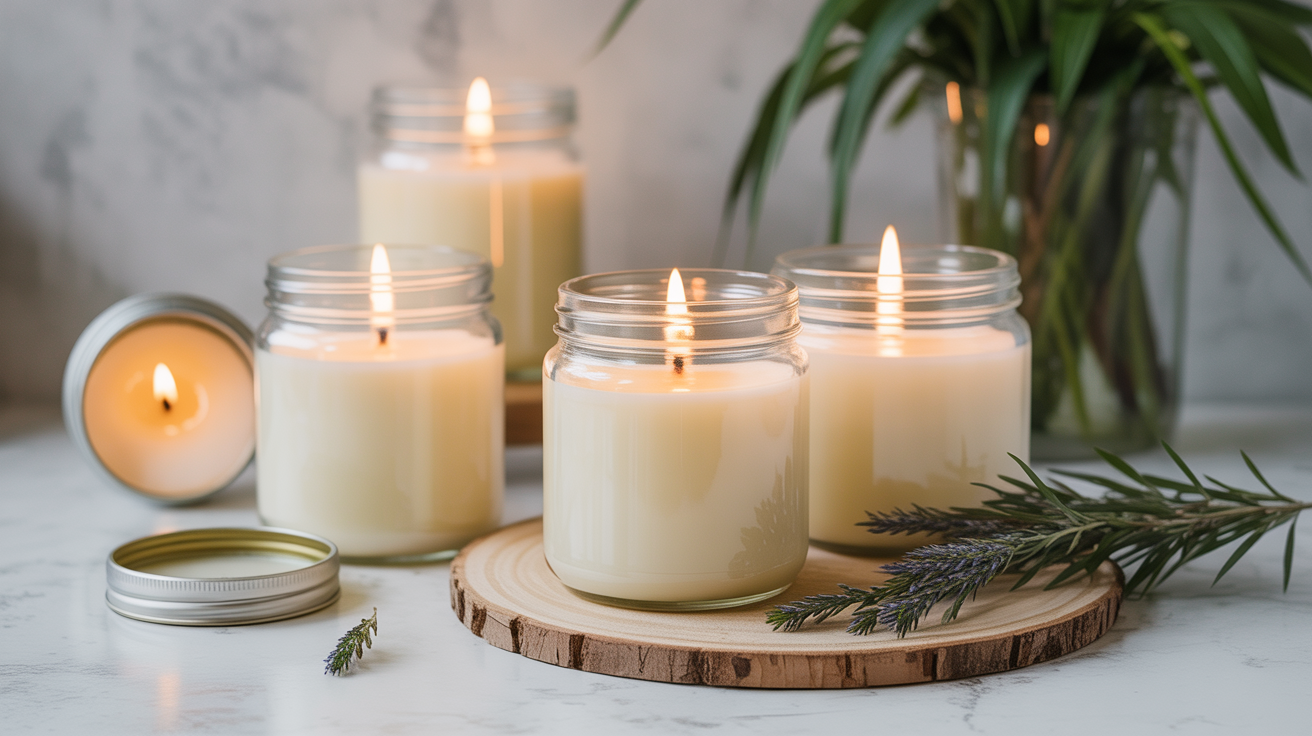
Making a scented soy candle in a jar is one of the most satisfying beginner projects you can tackle. The process takes about an hour of active time, costs less than $20 for your first batch, and produces a candle that genuinely works. This guide gives you a tested recipe for one 8 oz jar, with temperatures and timing so nothing is guesswork.
What You Need
Getting the supplies right before you start prevents mid-pour scrambling. Here's the complete list for a single 8 oz jar candle.
Equipment
- Double boiler (or a heatproof pitcher inside a pot of water)
- Kitchen thermometer (digital is easiest)
- Kitchen scale that reads in grams or ounces
- Wooden or silicone stir stick
- Wick centering tool or two chopsticks rubber-banded together
- Heatproof pouring pitcher (if not using one as the boiler insert)
Materials and Quantities
| Ingredient | Amount | Notes |
|---|---|---|
| Soy wax flakes (container grade) | 6 oz / 170 g | Fill weight, not jar volume |
| Fragrance oil | 0.5 oz / 14 g | ~8% of wax weight |
| Pre-tabbed wick (CD-18 or LX-18 for 3" jar) | 1 | Sized for your jar diameter |
| 8 oz glass jar (heat-safe) | 1 | Mason jars or dedicated candle jars both work |
| Wick sticker or hot glue | 1 dot | Anchors tab to jar bottom |
A quick note on fragrance load: soy wax holds fragrance well at 6 to 10 percent by weight. Eight percent (0.5 oz fragrance to 6 oz wax) sits comfortably in the middle and works for most fragrance oils. Going above 10 percent doesn't improve scent throw; it just increases the chance of seepage or poor adhesion to the jar.
For fragrance selection inspiration, see how to blend candle fragrances like a pro.
Step-by-Step Recipe
Before You Start
Set up your workspace on a heat-stable surface. Keep paper towels close, and have your jar and wick ready to go before the wax goes on the heat. You can't leave a hot double boiler unattended, so prep everything first.
Fix the wick: press a wick sticker (or a small drop of cooled hot glue) onto the metal tab, then press the tab firmly to the center of the jar bottom. Thread the wick through the centering tool and rest it across the jar opening so the wick stands straight.
Melt the Wax
- Add 6 oz of soy wax flakes to your pouring pitcher.
- Set the pitcher in a pot with 2 to 3 inches of water. Heat the water over medium heat.
- Stir the wax gently as it melts. Soy wax melts around 120 to 130°F (49 to 54°C).
- Heat the melted wax to 185°F (85°C). This is your fragrance-adding temperature. Higher than this and some fragrance molecules break down; lower and the fragrance doesn't bind as well.
- Remove the pitcher from the heat once you hit 185°F.
Add Fragrance
- Measure 0.5 oz (14 g) of fragrance oil on your scale.
- Pour the fragrance into the melted wax at 185°F.
- Stir slowly and steadily for 2 full minutes. This isn't optional. Thorough stirring gives the fragrance time to bind with the wax rather than just floating on top.
Pour
- Let the wax cool in the pitcher, stirring occasionally, until it reaches 135 to 145°F (57 to 63°C). This range gives the wax enough fluidity to settle without the surface shock that causes rough tops.
- Pour slowly into your prepared jar, leaving about half an inch of headspace at the top.
- Don't disturb the jar. Set it on a flat surface away from drafts and let it cool at room temperature. Cooling takes roughly 2 hours.
Fix the Sink Hole (If Needed)
- As soy wax cools, it sometimes pulls away from the wick and creates a small sinkhole around the wick base. This is normal. Once the candle is fully solid, poke 2 to 3 small holes around the wick with a skewer, then pour a thin layer of reserved wax (reheated to about 150°F / 65°C) to fill it in. Let it cool again completely.
Trim and Cure
- Trim the wick to ¼ inch (6 mm) above the wax surface before the first burn.
- Let the candle cure for 1 to 2 weeks before lighting it. This is the step most beginners skip, and it's the main reason a first candle smells weak. Curing gives the fragrance oil time to fully bind with the wax and distribute evenly. The scent throw of a 2-week-cured candle is noticeably stronger than one burned on day two.
Getting a Strong Scent Throw
Scent throw has two parts: cold throw (how the candle smells unlit) and hot throw (the scent you smell when it's burning). Here's what actually affects both.
Cure time matters most. Two weeks at room temperature, away from direct sunlight, makes a bigger difference than almost any other variable.
Jar diameter determines burn quality. A candle that pools edge to edge on the first burn has the right wick size. If you see a ring of unmelted wax at the edges after 3 to 4 hours of burning, the wick is too small for your jar. See easy beginner candle projects to try first for guidance on matching wick size to vessel.
Fragrance oil quality varies. Skin-safe body fragrance oils aren't always formulated for candles. Use candle-specific fragrance oils from suppliers that publish flash points (look for flash points above 170°F / 77°C for safety).
Room size affects perception. An 8 oz soy candle works well in a bedroom or bathroom. For an open living room, you'd need multiple candles or a larger vessel.
For seasonal fragrance ideas to try in your next batch, check out seasonal candle scent ideas for every time of year.
Safety Basics
Candle-making involves sustained high heat, and a few habits keep it safe.
- Never melt wax in a pot directly on the burner. The double boiler keeps wax below its flash point. Soy wax flash points typically sit around 300°F (149°C), but direct heat can cause uneven temperature spikes.
- Use only heat-safe glass jars. Thin glass, vintage jars, and decorative glassware can crack under sustained candle heat. Dedicated candle jars or wide-mouth mason jars are reliable.
- Never leave melting wax unattended. Step away and the water can boil off, leaving the wax on direct heat.
- Keep a lid or baking sheet nearby to smother a wax fire. Never use water.
- Work in a ventilated space, especially when adding fragrance oils, which can be strong at pouring temperatures.
Frequently Asked Questions
Why does my soy candle have a rough or bumpy top?
Soy wax is sensitive to temperature changes during cooling. A draft, a cold surface, or wax poured too hot can all cause bumpy tops or frosting. Pour between 135 and 145°F and let the candle cool in a room-temperature spot away from vents. A slight imperfection on the surface doesn't affect burn performance.
Can I use essential oils instead of fragrance oils?
Yes, but with limitations. Most essential oils have lower flash points than synthetic fragrance oils, which means they can evaporate before the wax binds them properly. You'll often get a weaker scent throw, and some essential oils (citrus especially) perform poorly in candles. If you use them, add at the lower end of the temperature range (closer to 175°F / 79°C) and keep the load at 6 percent or under.
How do I know if my wick is the right size?
Light the candle and burn it for 3 to 4 hours on the first use. If the melt pool reaches the jar's edges, the wick is correct. If unmelted wax remains at the edges (tunneling), the wick is too small. If the flame is very large, sooty, or mushrooming, the wick is too large. Wick sizing is something you dial in per jar and wax combination through testing.
My candle smells strong cold but weak when burning. What's wrong?
This usually points to one of two things: insufficient curing time, or a wick that's too small and not creating a full melt pool. Cure for the full 2 weeks first, then test the wick size. If the melt pool is reaching the edges but the throw is still weak, try a fragrance oil from a different supplier, as quality varies significantly between brands.
Is soy wax better than paraffin for scent throw?
Paraffin typically produces a stronger hot throw out of the gate because it holds fragrance at higher concentrations. Soy wax has a cleaner burn, is easier to work with at home (lower melt point, cleanup with soap and water), and produces a comparable throw when properly cured. For beginners, soy wax is the more forgiving choice.