Wax & Materials
How Much Wax Do You Need for a Candle?
Learn exactly how much wax you need for any candle jar using the simple water-weight method, plus a quick-reference table for common container sizes.
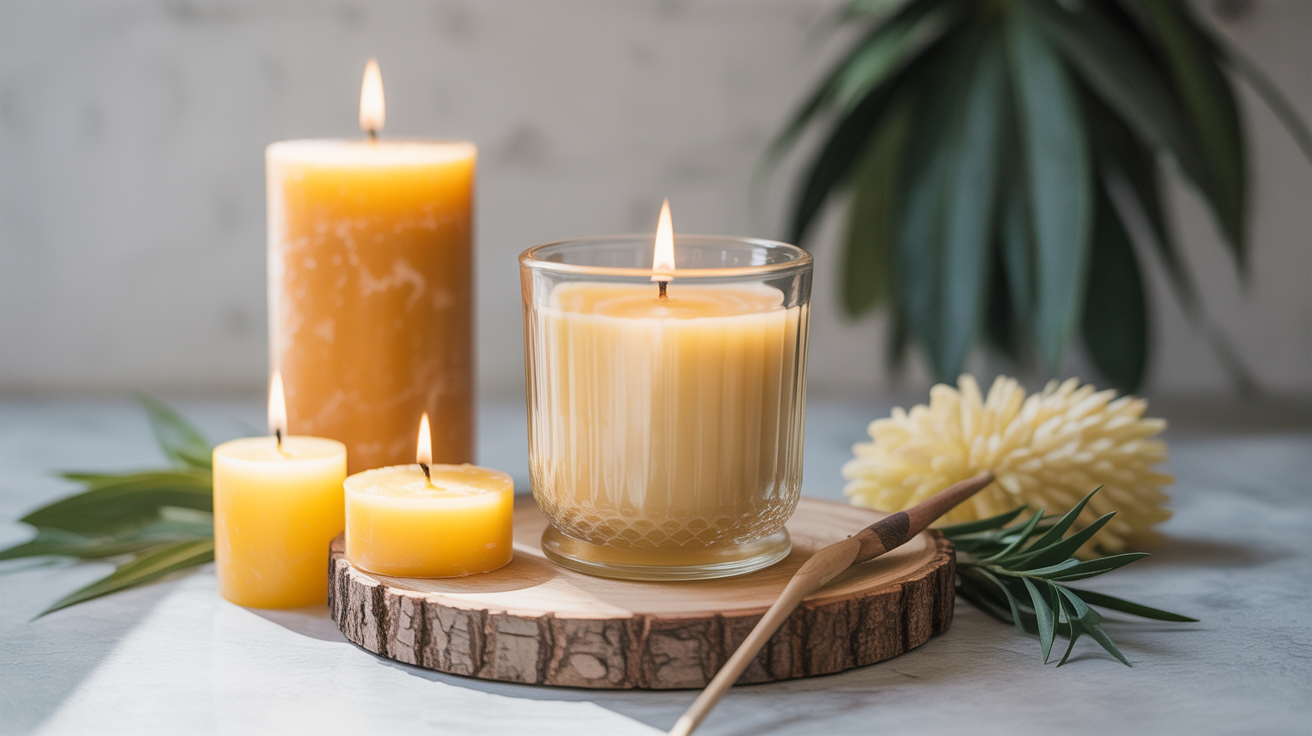
The fastest answer: fill your jar with water, pour that water onto a kitchen scale, and note the weight in ounces or grams. Multiply by 0.85. That number is roughly how much wax you need.
That method works for almost every container candle because wax is less dense than water. It won't win a chemistry prize, but it will get you within a few grams of the right amount every time.
At a Glance
- Water-weight method: weigh the water your jar holds, multiply by 0.85, and that's your wax weight.
- Use grams, not ounces, for anything under a pound. Grams give you far more precision on small batches.
- Standard fragrance load is 6-10% of wax weight; add that on top of the wax number, not instead of it.
- Add 10-15% extra wax when scaling up a batch to cover top-up pours and pitcher waste.
- Beeswax is denser than soy or paraffin, use a 0.95 multiplier instead of 0.85 for beeswax.
- Weight-based measurement, not volume, is the standard for a reason: solid wax flakes have air pockets that make cup measurements unreliable.
Why Wax Weighs Less Than Water
Water weighs 1 gram per milliliter (or about 1 oz per fluid oz, if you're working in imperial). Wax, soy, paraffin, coconut, beeswax, is lighter. Most container waxes have a density somewhere between 0.8 and 0.9 g/mL, which means a jar that holds 200 g of water will only take around 160-170 g of wax before it's full.
If you skip this adjustment and pour water weight worth of wax, you'll overflow the jar. The 0.85 multiplier splits the difference across common wax types.
A few specifics:
- Soy wax (container grade): ~0.85-0.90 g/mL
- Paraffin (container blend): ~0.85-0.90 g/mL
- Coconut wax: ~0.87 g/mL
- Beeswax: ~0.96 g/mL (denser, use a 0.95 multiplier instead)
For beeswax candles, the gap is smaller, but it still matters if you're filling a tight vessel. For everything else, 0.85 gives you a safe working estimate.
Measuring by weight rather than volume is not just a candle-making habit, it is the standard practice across consumer goods generally. The National Institute of Standards and Technology's Office of Weights and Measures exists specifically to keep weight-based measurement consistent and verifiable, which is why a kitchen scale reading in grams will always give you a more repeatable result than eyeballing a cup of flakes.
The Water-Weight Method, Step by Step
You don't need a spreadsheet or a specialty tool. All you need is a kitchen scale that reads in grams (grams give you more precision than ounces for small batches).
Step 1, Weigh your empty jar. Place it on the scale and tare it to zero.
Step 2, Fill the jar with water to your intended pour height. Most candle makers leave 0.5-1 cm of headspace at the top. Fill to that line.
Step 3, Weigh the water. Read the scale. Write it down.
Step 4, Multiply by 0.85. That's your wax weight for one candle.
Step 5, Add your fragrance weight on top. Fragrance load is typically 6-10% of the wax weight (more on this below). Wax and fragrance are calculated separately; the jar volume you measured already accounts for both if you use the 0.85 multiplier as a rough total, but a cleaner approach is to calculate wax first, then add fragrance on top and slightly underfill.
Keep a small notebook next to your scale. Once you know the wax weight for a jar you use regularly, you'll never have to measure water again. Over a dozen batches, that saved measuring step adds up to real time, and it also means you can spot a bad pour immediately if your weighed wax comes in noticeably off from your notebook figure.
Quick Reference: Common Jar Sizes
These numbers assume a standard container wax at ~0.85 g/mL density, poured to about 0.5 cm below the rim.
| Jar Size (fl oz) | Water Weight (approx) | Wax Needed (approx) | Wax at 8% Fragrance |
|---|---|---|---|
| 4 oz | 113 g | 96 g (3.4 oz) | 96 g wax + 7.7 g oil |
| 8 oz | 227 g | 193 g (6.8 oz) | 193 g wax + 15.4 g oil |
| 9 oz | 255 g | 217 g (7.7 oz) | 217 g wax + 17.4 g oil |
| 12 oz | 340 g | 289 g (10.2 oz) | 289 g wax + 23.1 g oil |
| 16 oz | 454 g | 386 g (13.6 oz) | 386 g wax + 30.9 g oil |
These are starting estimates. Your actual number may vary by a few grams depending on jar shape, headspace preference, and wax brand. Always weigh your first pour; don't rely on volume markings on the bag.
Scaling Up for Multiple Candles
Multiply your single-candle wax weight by the number of candles, then add 10-15% extra. That buffer covers:
- Top-up pours. Soy wax in particular sinks in the center as it cools. A second small pour smooths the surface. You'll need a small amount of leftover wax on hand.
- Waste in the pouring pitcher. A thin film always clings to the sides.
- Miscounts and accidents. A cracked jar or a dropped container is less annoying when you have spare wax.
Example: You're making 10 candles in 8 oz jars.
- Single candle: ~193 g of wax
- 10 candles: 1,930 g
- Plus 15% buffer: 1,930 x 1.15 = 2,220 g (about 4.9 lbs)
Most wax is sold in 1 lb, 5 lb, and 10 lb bags, so rounding to the nearest standard size is fine. For this batch, buy a 5 lb bag.
A second worked example makes the scaling pattern clearer. Say you're making 24 candles in 9 oz jars for a craft fair:
- Single candle: ~217 g of wax
- 24 candles: 217 x 24 = 5,208 g
- Plus 15% buffer: 5,208 x 1.15 = 5,989 g (about 13.2 lbs)
Round up to a 15 lb order if your supplier sells in that increment, or split the purchase across a 10 lb and a 5 lb bag. Buying slightly over is almost always cheaper than running out mid-batch and paying rush shipping for a small top-off order.
Accounting for Fragrance Oil
Fragrance oil adds weight and volume, so it factors into your planning even if it doesn't change your wax calculation much in practice.
The standard fragrance load for container candles is 6-10% of wax weight. Some waxes (certain coconut blends, for example) can hold up to 12%. Check the manufacturer's max load for your specific wax, exceeding it leads to fragrance pooling on the surface or seeping from the wick. Fragrance oils sold for candle use are formulated to comply with IFRA Standards, the fragrance industry's safety-based system that caps how much of a given ingredient can appear in a finished product. Those caps are about safety, not performance, but they are also the reason a supplier's recommended maximum load is worth respecting rather than treating as a soft suggestion.
To calculate:
- Wax weight x 0.06 = fragrance at 6%
- Wax weight x 0.10 = fragrance at 10%
Example: 193 g of wax at 8% fragrance load = 193 x 0.08 = 15.4 g of fragrance oil.
Add that amount to your wax when it comes off the heat (usually around 140-160°F / 60-71°C for soy, depending on the fragrance). Stir gently for two minutes to bind them.
A note on dye: liquid candle dye is used in such tiny quantities (often just a few drops) that it doesn't meaningfully affect your wax calculation. Solid dye chips add negligible weight. You can ignore both when calculating wax volume.
If you're still deciding what type of wax to use, types of candle wax explained for beginners covers the main options side by side. Or if you've already landed on soy, soy wax for candles: a complete beginner's guide walks through melt points, fragrance loads, and curing times in detail.
Frequently Asked Questions
Can I measure wax by volume instead of weight?
You can, but it's less accurate. Wax in solid form (flakes or pellets) has a lot of air in it, so a cup of wax flakes weighs far less than a cup of melted wax. Weight is the only reliable unit here. A $10 kitchen scale will save you more wax (and more failed candles) than almost any other piece of equipment.
My candle sank in the middle after cooling. Did I use too little wax?
Not necessarily. Soy and soy-blend waxes contract as they cool and often develop a dip or rough patch in the center. This is normal. Reserve about 10% of your melted wax, let the first pour cool completely, then do a small top-up pour to fill the crater. Pour the top-up at a slightly lower temperature (around 120°F / 49°C for soy) to avoid cracking.
How much wax do I need for a 4 oz candle?
A 4 oz jar holds roughly 113 g of water. At a 0.85 multiplier, you need about 96 g (3.4 oz) of wax. If you're adding 8% fragrance, that's about 7.7 g of fragrance oil on top. Round to 100 g of wax per candle and you'll have a comfortable buffer for the top-up pour.
Does the type of wax change how much I need?
Yes, slightly. Beeswax is denser than soy or paraffin, so it fills the same jar with a bit less volume, use a 0.95 multiplier for beeswax instead of 0.85. Coconut wax sits close to soy at 0.87. For most beginner projects using soy or a paraffin blend, 0.85 is the right number.
What if I don't want to use the water method?
The water method is the most practical approach for odd-shaped jars. For standard cylinder or straight-sided jars, you can also calculate volume geometrically (pi times radius squared times height for a cylinder, then multiply by 0.85), but that's more work for the same result. The water method is faster and accounts for any irregularities in the glass.
How do I calculate wax for an oddly shaped or handmade vessel?
The water method is exactly why it works better than geometry here. Fill the vessel with water to your pour line, weigh it, and multiply by 0.85, the same process regardless of whether the container is a perfect cylinder, a tapered tin, or a hand-thrown ceramic cup. This is the one scenario where trying to calculate volume mathematically genuinely costs you more time than the scale.
I'm out of wax mid-batch. Can I mix brands or wax types in one pour?
You can mix two batches of the same wax type (two different bags of soy, for example) without much concern. Mixing different wax types mid-pour, soy into paraffin, or coconut into beeswax, is riskier because melt points and shrinkage rates differ, and the result can set unevenly or develop cracks. If you're short, it's safer to finish the batch with what you have and treat the next pour as a fresh calculation with the new wax.