Wax & Materials
How to Color Candles: Dyes, Chips, and Pigments
Learn how to color candles using dyes, chips, and pigments. Beginner-friendly guide covering wax compatibility, safe temperatures, and how much color to use.
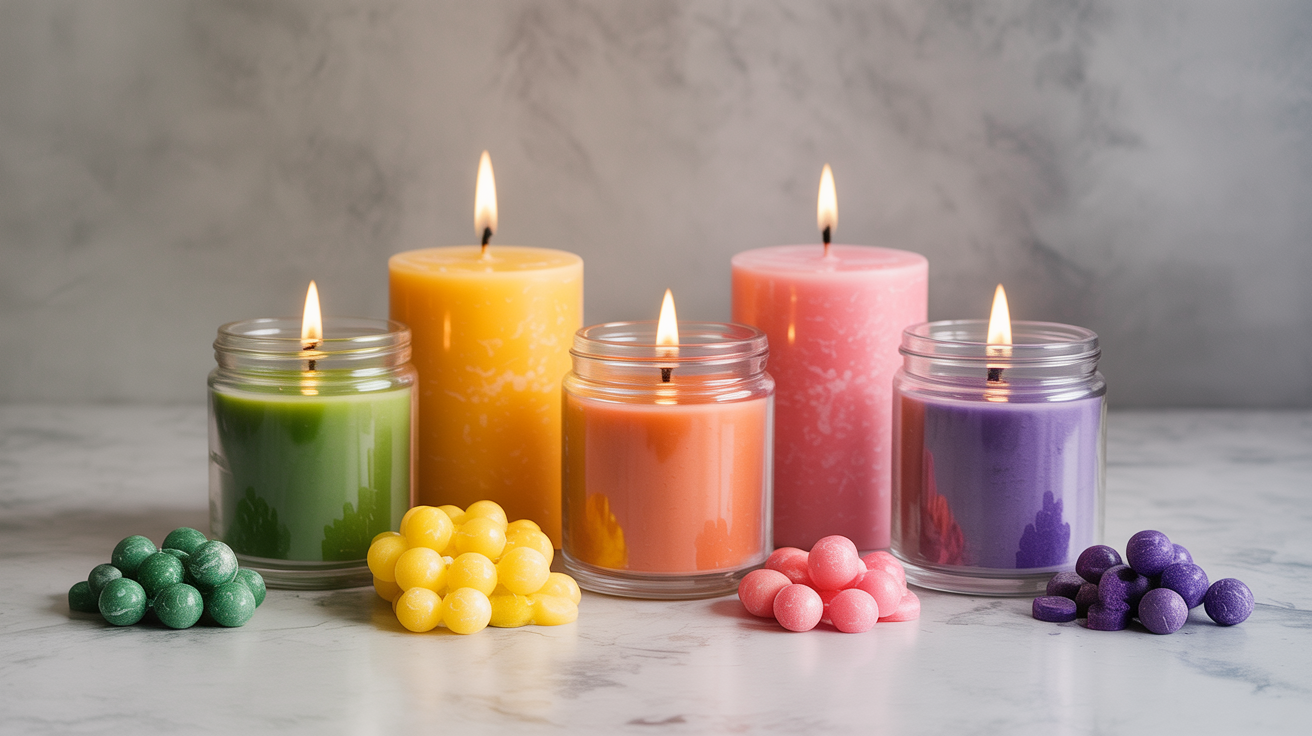
Adding color to a candle sounds simple until you realize there are three different product types on the shelf, each with its own behavior. Liquid dyes, dye chips, and pigments are not interchangeable, and using the wrong one can cloud your wax, clog your wick, or leave you with a candle that burns fine but looks nothing like you expected. Once you understand what each colorant actually does inside hot wax, choosing the right one for your project becomes a lot more straightforward.
This guide covers how each type works, when to add it during the pour process, how much to use, and a few safety habits that apply any time you are working with melted wax near heat.
The Three Types of Candle Colorant
Liquid candle dye is the most flexible option for beginners. It dissolves completely into melted wax, mixes easily to create custom shades, and gives you precise control because you add it drop by drop. A small bottle goes a long way. Because it fully integrates with the wax, it does not interfere with how a wick burns, which matters more than most beginners expect.
Dye chips (sometimes called wax dye blocks or color blocks) are essentially the same chemistry as liquid dye, just pre-measured into solid form. One chip colors roughly 1 pound (450 g) of wax to a medium shade, though this varies by brand. They melt right along with your wax, which makes them convenient and easy to store without the mess of liquid bottles. If you are making a consistent batch of the same color repeatedly, chips are usually the tidier option.
Pigments are a different category entirely. Candle-safe pigment powders and dispersions are finely milled colorants that suspend in wax rather than dissolving in it. Because they do not fully dissolve, they can settle in the container over time, which gives some pillar candles and wax melts a slightly mottled look that crafters actually like. The risk with pigments is using the wrong kind: cosmetic mica or craft pigments sold for soap or paint are often not formulated for candles and can clog wicks or release irritating fumes when burned. Only use pigments specifically labeled for candle making.
One colorant you should never use: crayons. They seem like an obvious hack, but crayon pigment is bound in a wax matrix with fillers that can clog wicks and create a sooty, uneven burn.
Wax Compatibility Matters
Not all colorants behave the same across wax types. Before you buy a bottle of dye, it helps to know what wax you are working with. If you are new to wax options, the guides on types of candle wax explained for beginners and soy wax for candles: a complete beginner's guide are worth reading first.
Soy wax tends to produce softer, more muted colors than paraffin, even when you use the same amount of dye. This is because soy wax is naturally off-white and opaque rather than clear. Expect your finished candle to look a shade or two lighter than the color of the melted wax in the pot. A medium red in the pot often becomes a dusty rose once cooled. Plan for this by testing a small pour before committing to a full batch.
Paraffin wax is the clearest of the common candle waxes, so colors come out more saturated and true to what you see in the melt. Liquid dyes and dye chips both work well.
Beeswax has a warm yellow-amber tone that tints every color you add to it. Blues shift green, whites turn ivory, and pale pastels nearly disappear. You can still color beeswax, but you work with the base color rather than against it. If you are new to beeswax, the guide on beeswax candles: pros, cons, and how to work with beeswax covers its quirks in more depth.
When and How to Add Color During the Pour
Timing is important. The goal is to add your colorant once the wax is fully melted and at the right working temperature, but before you add fragrance oil. Adding color early gives it time to mix thoroughly. Adding fragrance oil too soon can affect color dispersion if the wax cools unevenly.
For most soy and paraffin container waxes, the target melt temperature is around 170 to 185°F (77 to 85°C). Check your wax supplier's recommended melting temperature, because some specialty blends have narrower ranges. Never heat wax above 200°F (93°C) without a specific reason, and always use a proper wax thermometer rather than estimating by eye. Wax does not give obvious visual cues that it is overheating the way water does.
Add colorant at your working temperature and stir for at least 60 seconds to ensure it is evenly distributed. Then let the wax cool slightly to your fragrance-addition temperature (typically 130 to 145°F / 54 to 63°C for most soy waxes) before adding your scent.
How much colorant to use:
- Liquid dye: start with 3 to 5 drops per pound (450 g) of wax for a light tint, up to 10 to 15 drops for a deeper shade
- Dye chips: one chip per pound for a medium color is a reasonable starting point; adjust after testing
- Pigment: follow the manufacturer's recommendation, usually 0.1% to 0.5% by weight
These are starting points, not fixed rules. Pour a small test amount into a white ceramic dish or paper cup to see the cured color before committing to the full batch.
Mixing Colors and Keeping Records
You can mix liquid dyes to create custom colors, just like mixing paint. Red and yellow make orange, blue and red make purple. The main difference is that colors look darker in liquid wax than they do cured and solid, so you will need a few test pours to calibrate your eye.
Keeping a log is one of the most useful habits you can build early. Write down the wax type, the total weight, the colorant type and amount, and what the finished candle looked like after curing for 24 to 48 hours. This sounds tedious, but when you make a batch you love and want to replicate it three months later, those notes are the only reliable way to get the same result.
Candle color also shifts as the wax cures. Soy wax in particular can look quite different one day after pouring versus three days later. Always evaluate your color after a full 48-hour cure before deciding whether to adjust.
Safety Habits for Working with Hot Wax
Coloring candles does not introduce new safety concerns on top of normal wax work, but a few habits are worth reinforcing. Hot wax at 180°F (82°C) can cause a serious burn faster than boiling water, because it clings to skin rather than running off. Use a silicone-handled pouring pitcher, keep a lid or metal tray nearby to smother a wax fire (never use water), and work in a space with decent ventilation.
Keep your work surface covered with newspaper or a silicone mat because liquid dye will stain countertops, fabric, and flooring instantly. Even a small drip can permanently color a surface you did not intend to color. Nitrile gloves are worth wearing, especially when you are measuring pigment powders, which can irritate the eyes and respiratory tract if they become airborne.
Store leftover colorant with a label noting the product name and the batch date. Liquid dyes typically last one to two years when kept away from light and heat.
Frequently Asked Questions
Can I use food coloring to color candles?
No. Food coloring is water-based and does not mix into wax. It will either sit on the surface or create tiny water droplets in the wax that pop and spit when the candle burns. Use only dyes or pigments designed specifically for candle wax.
Why does my colored candle look faded after it cures?
Soy wax is naturally opaque, so all colors appear lighter once the wax solidifies. To get a more saturated result, increase your dye amount gradually and test cure small samples before scaling up. Paraffin and coconut wax hold color more intensely because they are clearer when solid.
Do colorants affect how a candle burns or smells?
Liquid dyes and dye chips formulated for candles should not affect burn quality when used in normal amounts. Adding too much dye, or using a non-candle-safe pigment, can clog the wick and cause it to mushroom, smoke, or extinguish prematurely. Colorants do not affect fragrance throw when used correctly.
Can I color beeswax candles?
Yes, but the warm amber base tone of beeswax will tint every color you add. Deep jewel tones like burgundy, forest green, or navy tend to show up best. Pale pastels often disappear into the background color. Test a small sample first to see how your chosen colorant interacts with the specific beeswax you are using.
Is there a difference between candle dye and soap dye?
Yes. Soap dye is formulated for a water-based, alkaline medium. Candle dye is formulated for wax. Some colorants work in both, but do not assume a soap dye is candle-safe unless the product label explicitly says so. Using soap dye in a candle can produce muddy color and unpredictable burn behavior.